
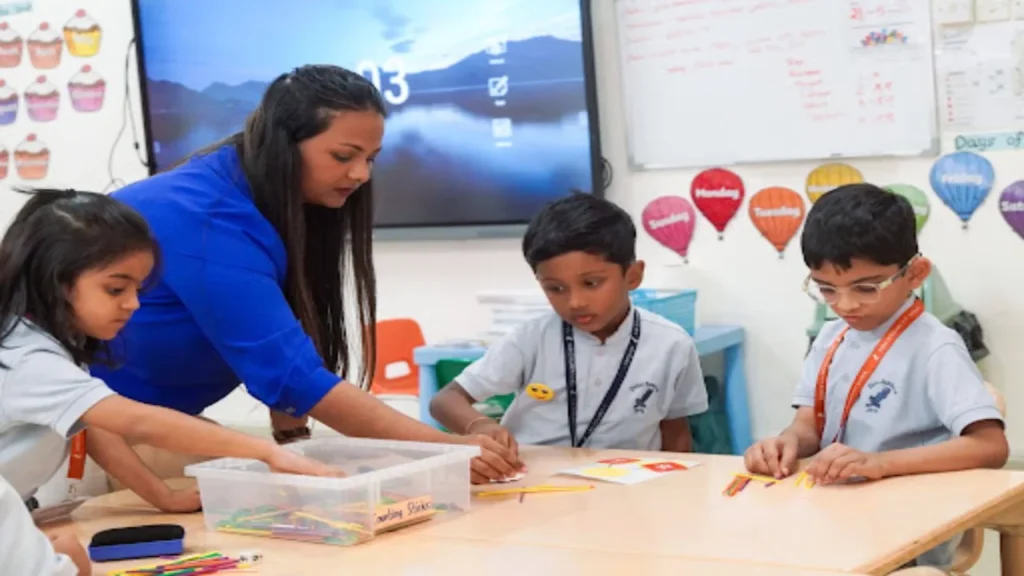
Phonics for kids is a method of teaching reading that links the sounds of spoken English to the letters that represent them. Children learn each sound, then blend sounds together to read words and break words into sounds to spell them. It is how reading is taught in British curriculum schools in Dubai from the Early Years through Year 2, and parents can support it at home in a few minutes a day.
What Is Phonics and Why Do Schools Use It?
English has 26 letters but around 44 sounds, called phonemes. Phonics teaches children which letter or group of letters, called a grapheme, stands for each sound. Once a child knows that the letters s, a and t make the sounds /s/ /a/ /t/, they can read “sat” without having seen the word before. This is called decoding.
The National Curriculum for England, which British curriculum schools in the UAE follow, expects children in Years 1 and 2 to use phonics as the main route to reading unfamiliar words. The approach is called systematic synthetic phonics: sounds are taught in a fixed order, and children practise blending them from the first weeks.
At What Age Do Children Start Phonics?
Phonics for kids usually begins with listening games at age 3, and letter sounds follow at 4. In Dubai, that usually means FS1 for sound awareness and FS2 for formal phonics, both part of the Early Years Foundation Stage, where literacy is one of the specific areas of learning.
Readiness matters more than the exact birthday. A child who can hear that “cat” and “hat” rhyme, or pick out the first sound in their name, is ready for letter sounds.
What Do Children Learn in Phonics at Each Stage?
Schools use different programmes, but the order of learning is similar across British curriculum schools:
| Stage | Typical age | What children work on |
|---|---|---|
| FS1 | 3 to 4 | Listening to sounds, rhymes, clapping syllables, hearing the first sound in a word |
| FS2 | 4 to 5 | Single letter sounds, blending simple words such as sat and pin, first tricky words, writing short words |
| Year 1 | 5 to 6 | Sounds made by two or three letters such as sh, ai and igh, alternative spellings, reading short books alone |
| Year 2 | 6 to 7 | Spelling patterns and word endings, reading with fluency, moving from decoding to understanding |
FS2 is the year when most of the core sounds are taught, which is why parents comparing FS2 in Dubai often ask how a school approaches early reading.
Phonics Terms Parents Hear From Teachers
- Phoneme: the smallest unit of sound, such as /m/ or /sh/.
- Grapheme: the letter or letters that write a sound, such as “m” or “sh”.
- Digraph and trigraph: two or three letters that make one sound, such as “ch” in chip or “igh” in night.
- Blending: joining sounds together to read a word: /d/ /o/ /g/ makes dog.
- Segmenting: breaking a word into its sounds to spell it.
- CVC words: consonant, vowel, consonant words such as cat, pen and sun, usually the first words children read.
- Tricky words: common words that do not follow the usual rules yet, such as the, said and was. Children learn these by sight.
How to Teach Phonics at Home
Five to ten minutes a day works better than one long session at the weekend. These steps support what your child is learning at school:
- Ask which sounds are being taught this week. Practising the same sounds at home reinforces the classroom rather than running ahead of it.
- Say pure sounds. Say /m/ as “mmm”, not “muh”. The extra “uh” makes blending harder: “cuh a tuh” does not sound like cat.
- Use letter sounds before letter names. Names matter later for spelling aloud, but sounds are what children need to read.
- Start with lowercase letters. Most of what children read is lowercase, so capitals can come once the sounds are secure.
- Let your child sound out before you help. If a word is decodable, give them time to blend it. Tell them tricky words straight away.
- Read the school reading book every day. These books match the sounds your child knows, so they can read most words independently.
Phonics for Kids: Activities to Try at Home
These phonics activities for kids take five minutes and need nothing more than paper, a pen or a set of magnetic letters:
- I spy with sounds: “I spy something beginning with /b/” builds the ability to hear first sounds.
- Sound hunt: look for one grapheme, such as “ee”, on cereal boxes, road signs and shop names.
- Magnetic letters: build cat, then swap one letter to make hat, mat and map.
- Robot talk: say a word in separate sounds, /s/ /u/ /n/, and let your child blend it back together.
- Write a shopping list together: your child segments each item and writes what they hear. Spelling does not need to be perfect.
Common Mistakes Parents Make With Phonics
- Teaching the alphabet song as the main route to reading, which teaches names rather than sounds.
- Encouraging children to guess words from pictures instead of sounding them out.
- Moving to harder books before the current sounds are secure.
- Correcting every error during reading, which turns a short session into a frustrating one.
Phonics for Children Who Speak Another Language at Home
Many children in Dubai learn English alongside Arabic, Hindi, Urdu, Malayalam or another home language. This is an advantage for language development, but some English sounds may be new to them. Standard Arabic has no /p/ or /v/ sound, so children may read “pen” as “ben” or “van” as “fan”. Speakers of Hindi and Urdu often hear /v/ and /w/ as one sound.
Keep using your home language for stories and conversation, because strong vocabulary in any language supports reading. For phonics practice, ask the teacher for audio or video examples so your child hears the English sound clearly.
Signs Your Child May Need Extra Phonics Support
Children learn at different speeds, and a slow start is common. Speak to the class teacher, and if needed the student support service, if your child:
- Still struggles to hear rhymes or first sounds by the end of FS2.
- Knows letter sounds on their own but cannot blend them into words in Year 1.
- Reverses or confuses the same letters and sounds for a long period.
- Avoids reading or becomes upset when asked to read aloud.
Early support is simpler than catching up later, and a short assessment can show whether the issue is hearing sounds, remembering them or blending.
Phonics at Dubai Scholars
Dubai Scholars follows the National Curriculum of England. In the Early Years, covering Nursery, FS1 and FS2 for children aged 3 to 5, communication and language is a prime area and literacy a specific area of learning, and FS2 gives particular emphasis to phonics alongside early numeracy and play based learning.
Phonics then continues through Key Stage 1 (Years 1 and 2), which has its own Deputy Head within the British curriculum primary programme. Children move from decoding single words to reading books with fluency.
Once phonics is secure, reading events and a Reading Club for Years 3 to 6, led by the Junior Student Council, keep children reading for enjoyment.
To see Early Years and Key Stage 1 classrooms in action, book a school tour.
Frequently Asked Questions
What age should a child start phonics?
Listening and rhyming games can start at 3. Formal letter sounds usually begin at 4, in FS2, when most children can hear and repeat individual sounds.
How long does it take to learn all the phonics sounds?
Most children learn the main single letter sounds during FS2 and the remaining sounds and alternative spellings across Year 1. Applying them fluently in reading takes until the end of Year 2 for many children.
Should I teach capital or lowercase letters first?
Lowercase first. Children see lowercase letters in almost every word they read, and capitals are easier to add once the sounds are known.
Is phonics enough to make my child a good reader?
Phonics teaches children to decode words. Understanding what they read also depends on vocabulary and talk, which is why reading aloud together every day still matters once your child can read alone.